
Chronology
In memory of Galileo
after 1642

Between
1633 and 1637 Francesco Montelatici, known as Cecco Bravo, painted in the
"Studio" of the house that had been the residence of Michelangelo Buonarroti,
the portraits of illustrious Tuscan mathematicians and astronomers. Among these
can be seen Galileo, who with his telescope and an open book before him,
probably an allusion to the Sidereus
Nuncius [Starry Messenger] (Venice,
1610) is showing the surface of the Moon. The work was completed in the years
when Galileo was still alive and had already been condemned by the Court of the
Inquisition. The patron, Michelangelo Buonarroti the Younger, thus showed
remarkable courage in celebrating a man deemed to be "strongly suspected of
heresy".
After
the death of the Pisan scientist, Vincenzo Viviani expended great energy in the
project for erecting a monumental tomb, to take the place of the little one in
the room below the bell tower of the
Church of Santa Croce. In this project,
however, he was unable to overcome the
resistance of the ecclesiastical authorities. For this reason Viviani
decided, in 1690, to decorate the facade
of his own palazzo as the first public monument dedicated to Galileo, having
placed on it two large scrolls bearing inscriptions praising the Master's
discoveries, a bust of the scientist and two bas-reliefs recalling some of his
discoveries.
It
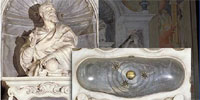
was only in 1737 under Giangastone, the last of the Medici Grand Dukes, that
the monumental tomb to which had been brought the mortal remains of Galileo and
his faithful disciple Viviani was inaugurated in the Basilica of Santa Croce,
facing the tomb of Michelangelo.